
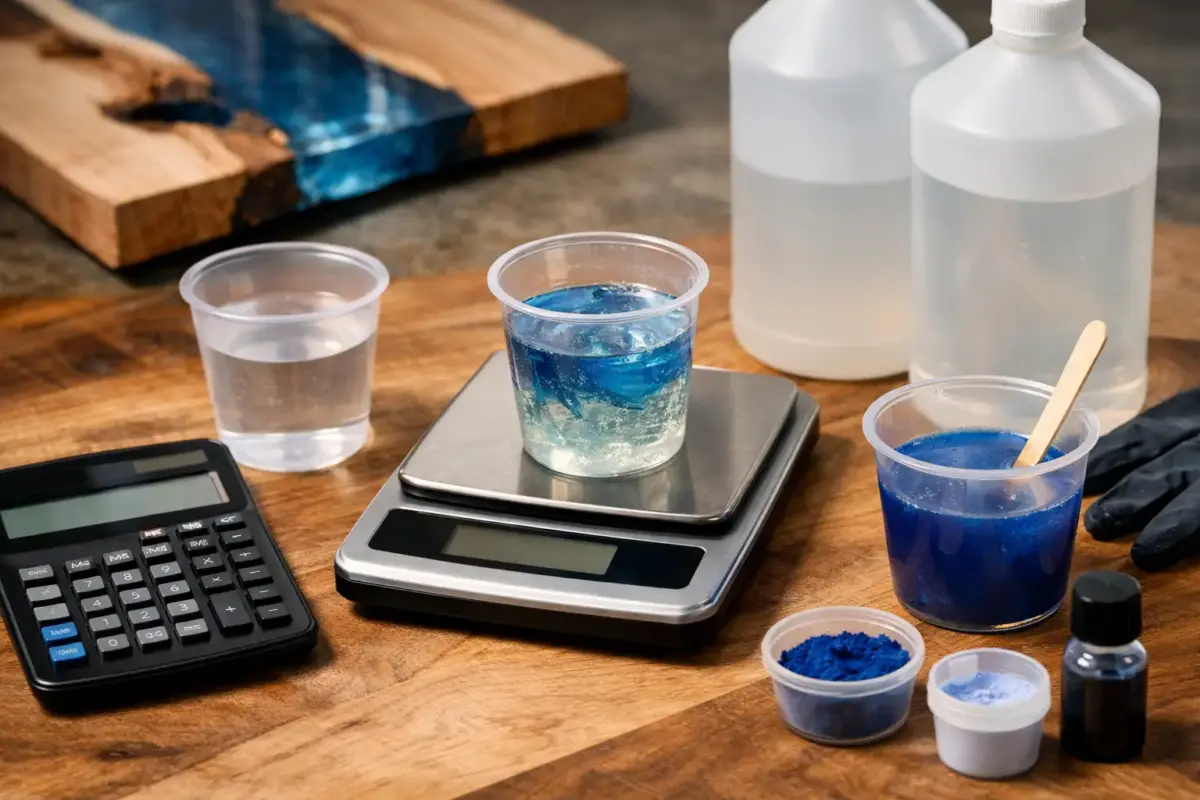
You only need to run short on resin once to remember it. Half-filled moulds, a thin flood coat that does not quite reach the edge, or the panic of mixing a second batch mid-pour – none of it is ideal. An epoxy resin calculator helps you work out how much resin you need before you start, which means less waste, fewer surprises, and a much smoother project from mixing cup to cure.
For resin makers, that bit of planning makes a real difference. Whether you are pouring jewellery moulds at the kitchen table, coating a serving board, or topping up stock for your small business, getting the volume right saves money and helps the finish look more professional.
What an epoxy resin calculator actually does
At its simplest, an epoxy resin calculator estimates the volume of resin needed to fill a space. That space might be a mould cavity, a tray, a tabletop, a geode-style artwork, or a silicone form with several compartments. You enter the dimensions, usually length, width and depth, and the calculator converts those measurements into a resin volume.
That sounds straightforward because, in many cases, it is. Flat rectangular pours are easy to predict. But resin projects are not always neat boxes. Some moulds taper, some have raised details, and some artistic pours are intentionally uneven. That is why a calculator is best used as a practical guide rather than an absolute promise down to the last millilitre.
The useful part is not just the number itself. It is the confidence it gives you before you mix. You can check whether one bottle is enough, decide whether you need a larger kit, and avoid overbuying for smaller projects.
Why getting the volume right matters
Resin is not a material you want to guess with. Mix too little and you may have to rush a second batch, which can create visible lines, uneven curing, or subtle differences in tint if pigments are involved. Mix too much and you waste both resin and colourants, especially on small decorative pieces where overestimating by even a little can add up over time.
There is also the issue of timing. Once mixed, epoxy resin has a working window. If you are spending that time scraping leftover resin from a cup you did not need to fill in the first place, you are not focusing on your pour, your bubbles, or your finish.
For beginners, this is often where projects start to feel more technical than expected. For experienced makers, it is simply about efficiency. In both cases, a calculator takes away one of the most common sticking points.
When an epoxy resin calculator is most useful
An epoxy resin calculator is especially handy for projects with measurable dimensions. Think coaster moulds, letter moulds, trays, bookmarks, chopping board coatings, table inlays and artwork panels. If you can measure the space being filled, you can get close enough to plan with confidence.
It is also useful when you are comparing products. Different projects call for different resin types, and each one needs to be bought in practical quantities. A deep pour cast, for example, may require much more resin than a shallow top coat, even when the piece looks similar from above.
If you sell your makes, this matters even more. Knowing roughly how much resin goes into each item helps with pricing, batch planning and reordering. It is much easier to keep your workflow moving when you know what each product actually consumes.
Measurements that give you better results
A calculator is only as good as the measurements you put into it. The basic rule is simple: measure the area that will actually be filled, not the outer edge of the mould or blank.
For rectangular pieces, measure the internal length, internal width and intended pour depth. For circular moulds, use the diameter and depth. With irregular moulds, the best approach is to measure the widest practical points and remember that the result is still an estimate.
Depth is where people often get caught out. If your mould is 20mm deep but you only want a 10mm pour, use 10mm. If you are adding inclusions like dried flowers, stones or shells, remember they displace some resin. In that case, the calculator may slightly overestimate, which is usually better than coming up short.
It also helps to stick to one unit of measurement throughout. Millimetres and centimetres are both fine, but mixing units tends to create the sort of maths error that follows you all the way to the mixing bench.
The shapes that are easiest – and hardest – to estimate
Simple shapes are the most reliable. Squares, rectangles and circles behave well because their volume is predictable. A coaster set, a flat art panel or a clean-edged tray is usually easy to calculate and pour.
More complex shapes need a little judgement. Geode art, domed surfaces, moulds with multiple channels, or pieces with built-in texture can all affect how much resin is really needed. If the surface is uneven by design, the number from the calculator should be treated as a sensible starting point rather than a fixed target.
For highly detailed moulds, it is often worth adding a small buffer. Not a huge excess, just enough to account for corners, raised edges and a little resin left behind in the mixing cup.
Why a small extra margin is often sensible
Most resin makers eventually learn that exact calculations and real-world pours are not always identical. A little resin clings to mixing cups and stirrers. Some stays behind on gloves or tools. Some projects need a touch more than expected to level out cleanly.
That is why many people mix a little extra, especially for coatings and decorative moulds. The key word is little. You want enough to finish the job comfortably, not so much that you create unnecessary waste.
How much of a margin makes sense depends on the project. A tiny jewellery mould does not need much room for error. A larger tray, artwork panel or board coating usually benefits from a bit more flexibility.
Calculator first, mixing ratio second
One point worth separating out is this: volume needed and mixing ratio are not the same thing. An epoxy resin calculator tells you how much mixed resin your project needs. Your product instructions tell you how to combine part A and part B correctly.
That distinction matters. Even if you estimate the right overall amount, inaccurate measuring during mixing can still lead to sticky spots, soft cures or surface issues. Always follow the product’s stated ratio by weight or by volume, depending on the resin you are using.
This is where beginner-friendly tools really help. Once you know the target amount, the rest becomes a much more manageable process – choose the right resin, measure carefully, mix thoroughly, then pour with confidence.
Common reasons calculations go wrong
The most common issue is measuring the wrong dimensions. People often use the outer size of a mould rather than the internal cavity, or they forget that the pour depth is shallower than the total depth.
The second issue is ignoring shape. A mould with curves, bevelled sides or decorative detail will not always behave like a plain block. The third is forgetting about inclusions and add-ons. Glitter will not change volume much, but bulky embeds certainly can.
Then there is plain overconfidence. It is easy to think you can eyeball a project after a few successful pours. Sometimes you can. Sometimes you end up scraping the last drops from a cup and wishing you had spent thirty seconds checking first.
A better way to plan resin projects
Using a calculator is not about making resin crafting feel clinical. It is about giving your creative ideas a better starting point. When you know the likely volume, you can choose the right bottle size, prep the correct number of mixing cups, and work more calmly once the clock starts on your pot life.
That is especially useful if you are building a proper setup at home or making items to sell. Good results rarely come from guesswork alone. They come from having the right resin, the right tools, and enough clarity to enjoy the process instead of second-guessing it.
For many makers, that is the point where resin becomes much more enjoyable. Less mental maths, fewer mix-up moments, and more attention left for colour, finish and design.
If you are planning your next pour, an epoxy resin calculator is one of the simplest ways to start well – and starting well usually means a project that looks better at the end.