
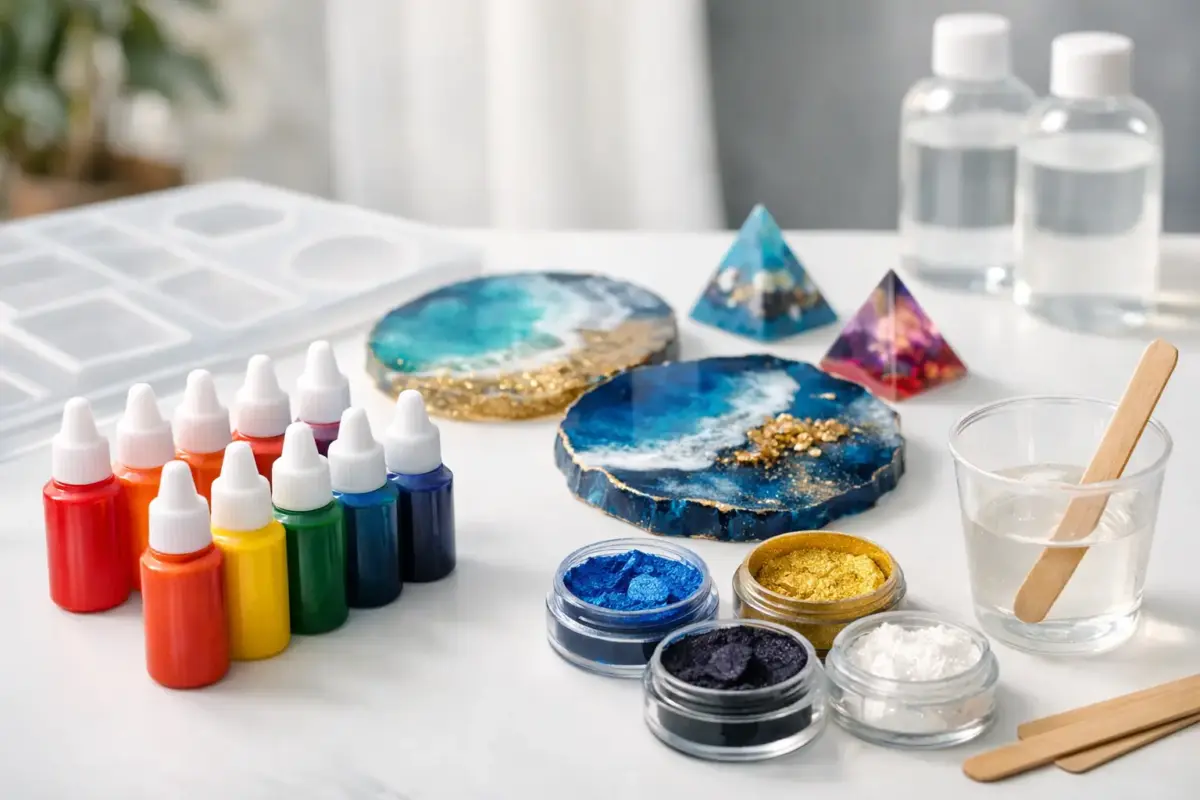
That moment when clear resin is mixed and ready to tint is where a project really starts to feel personal. The right resin pigment set can turn a simple pour into marbled coasters, bold jewellery, smoky trays or neatly branded pieces for your small business. The challenge is that not all pigment sets behave the same way, and choosing the wrong one can leave you with muddy shades, weak colour, or a finish that is not quite what you had in mind.
If you are buying pigments for the first time, or replacing a set that never quite delivered, it helps to shop with the finished result in mind. Colour is only one part of the decision. Opacity, mixing ease, resin compatibility and the kind of projects you make all matter just as much.
What makes a good resin pigment set?
A good set gives you control. That sounds simple, but it is the difference between guessing and creating with confidence. You want colours that disperse evenly, show up clearly in resin, and let you build either soft tints or stronger, more opaque effects without using so much product that you affect the cure.
For most makers, a useful resin pigment set also needs variety. A tightly chosen range of core shades often works better than a huge box of similar colours you may never touch. White, black, red, blue, yellow and a few secondary tones give you room to mix custom shades, while metallics, translucent tints or special-effect pigments can add more creative options once your basics are covered.
Packaging matters more than people expect. Bottles, pots and sachets each suit different working styles. Dropper bottles are handy when you want repeatable results in small pours. Pots can be easier for thicker pastes or powders. If you sell your work, consistency from batch to batch becomes a real consideration, not just a nice extra.
Types of pigments in a resin pigment set
Not every pigment creates the same finish, even when the shade on the label looks similar. This is why a resin pigment set should be chosen by effect as much as by colour chart.
Liquid pigments
Liquid pigments are one of the easiest places to start. They mix in quickly, are simple to measure in small amounts and are ideal for flat, even colour. If you make coasters, bookmarks, keyrings or moulded homeware, they are often the most straightforward option.
They are especially beginner-friendly because you can add colour gradually. A drop or two may be enough for a translucent tint, while a little more gives stronger coverage. The trade-off is that some liquid pigments are better for solid colour than for dramatic shimmer or movement.
Mica powders
Mica powders bring shimmer, depth and a more decorative finish. They are popular for geode designs, jewellery, trays and statement pieces where the surface needs to catch the light. They can also be brushed into moulds before pouring for more defined detail.
The trade-off with mica is that it does not behave like a flat dye. That sparkle is the whole point, but if you want a completely plain block colour, liquid pigment may be the cleaner choice. Powders also need proper mixing to avoid tiny specks sitting unevenly in the resin.
Paste pigments and opaque colourants
If your aim is strong coverage, paste-style pigments or highly opaque colourants are worth a look. These are useful when you need a true white, a dense black or a solid background that will not disappear into the clear resin.
They can be brilliant for layered pours and mould work where sharp contrast matters. The key is moderation. Heavy-handed use can interfere with the balance of the resin, so it is always worth following the usage guidance for the product you choose.
How to choose the right set for your projects
The best set for one maker can be completely wrong for another. A beginner making gifts at the kitchen table does not need the same range as a seller producing matching product lines every week.
Start by thinking about scale. If you usually work on small jewellery moulds, a compact set of concentrated colours may last a surprisingly long time. If you pour larger trays, artwork or home décor pieces, you may get through white, black and metallics much faster than the brighter shades.
Next, think about finish. Do you want transparent colour, soft pastel tones, dense opacity or shimmer? A lot of buying mistakes happen because shoppers choose by the photo on the box rather than the effect they need in the resin itself. A beautiful set can still be the wrong set if the finish does not match your style.
Then consider how much experimenting you actually enjoy. Some makers love mixing custom shades from a few primaries. Others would rather have a broader ready-made palette that speeds things up. Neither approach is better. It just depends on whether you want creative flexibility or convenience.
Resin pigment set options for beginners
For beginners, simplicity usually wins. A smaller resin pigment set with dependable core colours is often far more useful than a large collection packed with niche tones. You will learn faster when you can see how a few colours behave in clear resin, white resin and layered pours.
It also helps to choose pigments that are clearly intended for resin rather than general craft use. Resin is sensitive to what gets added to it. Using the right colourants reduces the guesswork and makes it easier to avoid problems with texture or curing.
If you are just getting started, think beyond pigments too. The colouring stage sits in the middle of the whole process, so having mixing cups, stirrers, gloves and suitable moulds close at hand makes everything easier. This is one reason many makers prefer buying from a specialist shop such as Resin Studio, where the full workflow is easier to organise.
What experienced makers should look for
Once you know your style, a good pigment set becomes less about trying everything and more about filling practical gaps. You may want refill-friendly colours you use every week, or specialist shades that help your products stand out at markets and online.
Experienced resin users often care more about consistency. If you are making repeat collections, you need colours that stay reliable across batches. You may also want a set that works well alongside mica powders, flakes, inks or embedding techniques without becoming unpredictable.
This is where curated sets can be more useful than oversized mixed bundles. A set with purposeful shades and dependable performance often earns its place on the bench faster than a novelty-heavy range.
Common mistakes when using resin pigments
Most pigment problems come down to quantity or compatibility. Adding too much colourant is a common one. It is tempting to keep squeezing in more until the resin looks perfect in the cup, but overloading can affect how the resin cures.
Poor mixing is another issue. Streaks can be intentional in some designs, but unmixed pockets of pigment are not. Stir thoroughly and scrape the sides and base of the cup so the colour disperses evenly.
It is also worth remembering that colour can shift slightly once poured into a mould or over a white background. Transparent shades may look deeper in the mixing cup than they do in a thin cast. Testing a small amount before a larger project can save both resin and frustration.
Building a colour collection without overbuying
It is easy to collect more pigments than you need. A better approach is to build in stages. Start with a practical set that covers everyday shades, then add effect pigments based on the projects you genuinely make.
If your style leans towards neutrals, florals or wedding pieces, you may get more use from whites, golds, blush tones and soft greens than from neon brights. If you make gaming dice, statement jewellery or abstract art, bold colour and contrast may matter more. Buying to suit your actual workbench, not an imaginary future style, keeps things focused.
There is also no rule that one set must do everything. Many makers end up with one core resin pigment set for reliable base colours and a second group of shimmer or special-effect pigments for more decorative work. That tends to be more practical than expecting a single box to cover every idea.
So which resin pigment set is worth buying?
The best choice is the one that suits your resin type, your usual projects and your confidence level. For beginners, that often means an easy-to-use set with strong everyday shades and clear resin compatibility. For regular makers, it may mean better opacity, repeatable results and colours that fit a recognisable product style.
A resin pigment set should make creating easier, not more confusing. If the colours are dependable, simple to mix and suited to the finish you want, you are far more likely to enjoy the process and get pieces you are proud to keep, gift or sell.
Choose the set that helps you pour with confidence, then give yourself room to experiment. Some of the best resin work starts with one colour you were not quite sure about.